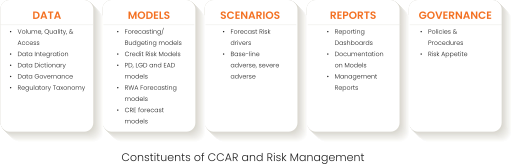
As banks face increasingly complex regulations and market pressures, the importance of comprehensive risk management practices cannot be overstated. Taking calculated risks with investments is a key part of their business strategy. Still, when risks are not properly managed, they can lead to high losses, defaults, and even financial crises.
The Comprehensive Capital Analysis and Review (CCAR) is extensively acknowledged to exert significant influence on the risk management and business practices of Bank Holding Companies (BHC). Though compliance with CCAR requirements is mandatory, it is only one aspect of effective risk management. To truly manage risk, banks must go beyond regulatory conformity and leverage granular analytics to gain deeper insights into their operations and exposures.
This whitepaper will explore how granular data analytics can drive effective CCAR and risk management practices, enabling banks to proactively identify and mitigate risks while optimizing their capital allocation and investment strategies.
The comprehensive capital analysis and review (CCAR) is vital for US banks to ensure they have enough capital to withstand an economic downturn. The process introduced by the US Federal Reserve applies to BHCs with total assets of $50 billion or more to assess their capital adequacy and planning.
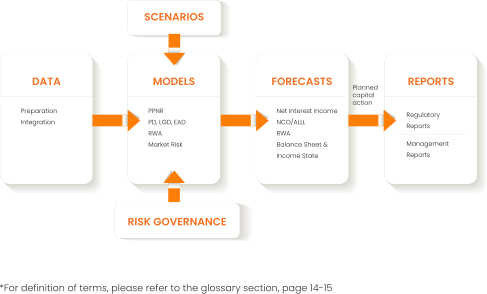
Banks must undergo a rigorous stress test to determine their ability to withstand economic shocks, with CCAR results determining their ability to return capital to shareholders. Banks submit annual, quarterly and monthly capital plans for approval, detailing their internal processes for assessing capital adequacy and planned capital actions over a nine-quarter planning horizon based on projected capital levels and ratios under various stress scenarios.
The CCAR process is conducted annually and involves two main components: a quantitative evaluation and a qualitative evaluation.
The quantitative evaluation assesses the capital adequacy of banks by subjecting them to a series of stress tests that simulate severe economic scenarios. The results of the stress tests are used to determine whether the bank has sufficient capital to absorb losses and maintain its operations during a crisis.
The qualitative evaluation assesses the bank’s capital planning processes, including its governance, risk management and internal controls.
Though CCAR is a regulatory requirement, it is primarily a key risk management tool for banks. By leveraging its process and reporting requirements, they better understand risk exposures and develop stronger risk management practices.
The CCAR process relies heavily on data analysis using internally generated and Federal Reserve-provided stress scenarios. Banks continuously explore new ways to leverage data to enhance their risk management strategies, making analytics-driven risk intelligence an integral part of their business operations.
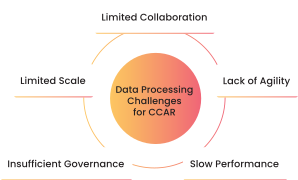
However, getting insights from data is more of a challenge than an opportunity for large banks. Though digital transformation has been a top priority, the age-old banking industry has not been quick enough to adapt to change. Some of these challenges that banks encounter occur due to the reasons discussed in the following sections.
CCAR reporting mandates identifying and documenting of potential capital risks across several economic stress scenarios. Given the data size and complexity of running this analysis, traditional IT systems can’t handle this workload, leading to performance issues such as slow response times & inadequate insights into potential risks.
The inability to generate real-time reports and analysis thwarts agile reactions to evolving market conditions. Such inefficiencies can also negatively impact a bank’s overall risk profile and financial performance.
As banks have grown in business verticals and complexity, they have struggled to manage the exponential growth of data amassed, requiring processing at high speeds. This challenge is compounded by the growth of layered and disparate IT systems with no common data governance policies.
Aggregating and managing such vast amounts of data across multiple systems and accurately reporting financial and risk positions to regulatory agencies within stipulated timeframes become a struggle.
Stress testing, which requires analyzing large volumes of data across various scenarios, is particularly challenging. Analytical tools are limited in their ability to produce valuable insights. There is a delay due to dependence on specialized analysts’ skills.
With these difficulties, obtaining a comprehensive understanding of risk exposure across different business lines, geographies and asset classes and meeting the periodic CCAR reporting deadlines is a tall order.
Plus, legacy systems in most banks pose significant challenges as they operate in silos, making it difficult to integrate data from different sources and accommodate large data sets. They need more flexibility to integrate with cloud-based infrastructure or modern BI and Analytics platforms that are the backbone of risk management strategies.
Since different lines of businesses, asset classes and products have unique risk management practices, they are not always aligned. When these practices are integrated, it can lead to an accurate or complete view of overall risk exposure, resulting in better decision-making.
Without proper collaboration, developing an across-the-board understanding of how different risk areas interconnect or weigh upon each other is challenging. This can lead to inadequate controls, misaligned risk appetites and increased exposure to operational losses.
CCAR requires analysis and reporting at a detailed level by individual business line, product type or geographic region. This is to identify risks and vulnerabilities that may not be apparent in the aggregated data. Risk management strategies may thus be tailored to specific areas of the organization rather than being applied uniformly across the board.
Granular analytics require data to be accurate and consistent across all levels of analysis and can drill down into transaction levels with agility. Analytics tools need to handle disparate data structures, and risk analysts should deeply understand the data and its sources.
Given the complexity and requirements for granular-level analytics for CCAR reporting, advanced data analysis tools that use machine learning and predictive modeling techniques are needed.
When banks lack the capability to ensure data accuracy, security and traceability, inconsistencies, and errors occur, leading to incorrect risk assessments. Such inaccuracies can cause financial losses, regulatory penalties and reputational damage.
Additionally, banks often struggle to protect sensitive risk data. With no clear data governance structure, there is no accountability or commitment to ensuring data integrity. Data ownership, governance and business alignment are critical for effective risk reporting.
To counter the above-stated challenges, risk analysts at global financial institutions are exploring new paradigms of analytic algorithms to support faster decision-making and rapid risk transformations. Removing data and analytics roadblocks is the first step in the right direction, mainly when dealing with siloed information and high data influx.
A comprehensive and unified view of regulatory deviations can help implement timely safeguards and mitigate risks before they seriously damage the bank’s reputation and finances. Kyvos offers a high-performance semantic layer along with enterprise security guardrails. The platform drives efficiencies and uncovers data-driven methods to curb financial crimes. Here are some key benefits this approach offers:
More than an event-driven loss evaluation, risk management for CCAR needs forward-looking analytics when working with millions or even billions of financial records. The process has no scope to allow latencies or redundancies.
An ideal solution would be to invest in an analytical infrastructure that enables users to explore any volume of historical data interactively. While legacy platforms may be insufficient to meet these goals, AI-powered smart aggregation technology can help build smart aggregates that deliver faster performance, higher scalability and more responsive analytics.
Leveraging the computing power of the existing data warehouse or lake, they can help process billions of rows of data across multiple dimensions and hierarchies. Also, the analysts can load this data into the company’s data warehouse for SQL reporting, including ad hoc querying by multiple users concurrently.
CCAR yearly supervisory rules present new datasets for stress tests and estimates for various risk categories. This helps in building optimized models on complex data to ensure instant responses across hundreds of measures and dimensions.
Banking organizations have vaulted risk management at the top of strategic plans. Yet, risk models falter due to delays in fetching answers to critical business queries. For proactive risk analytics, analysts need undisrupted addition of new smart aggregates instead of time-consuming and error-prone manual processes.
Incremental data refreshes can reduce downtime and allow interactive access to newly ingested data instantly. Faster data processing with automated dashboard refreshes also enables seamless adjustments and adaptability to new market requirements without needing significant rework or redesign from risk analytics teams.
Once risk analysts create complex risk models and profiles, they need faster responses based on data-driven and action-oriented insights. Answering every what-if scenario depends on multidimensional analysis that drills down and slices-dices in every potential direction. Users can then extract information required for timely action.
Using a robust querying mechanism, Kyvos’ in-built query engines can respond to any complex calculation or simulation within split seconds. The system identifies the right engines for every specific query and serves it accordingly. An advanced indexing technique enables extremely small semantic models that save disk space and helps create larger models for faster processing.
Since accurate risk assessment and subsequent management rely on extreme precision even when working with approximate data, CCAR teams need exact decimal support for integer-based calculations and binary-to-decimal rounding.
Tools like Excel allow up to 15 digits before rounding the number, but this can be problematic when working with a report having similar data types but with different values. Kyvos offers precision up to 38 digits and validates financials up to 13 decimal points for accurate risk reporting and response.
A platform-agnostic semantic layer between enterprise-specific analytics tools and data storage can enable granular-level access controls to protect sensitive data against any breach while ensuring compliance with all regulatory requirements.
Kyvos enables a multi-tiered architecture to ensure complete data protection across the stack at group or individual levels. Authorization, authentication, encryption and role-based access controls apply to all applications. Users may be restricted from viewing specific measures, dimensions or rows when accessing data.
The ongoing cross-pollination of risk analytics methodologies has led to higher adoption of different analytics tools to serve different functions for FP&A teams. The native dialect of each tool is different, which results in different versions of the same data.
The semantic layer enables a unified data view across the board by understanding these different dialects and defining metadata in one place. As a result, business users can access a single source of truth with complete trust in the integrity and consistency of responses they get to any query.
Kyvos helps resolve all analytical challenges for global banks seeking to comply with CCAR-related regulations. Here’s proof:
The risk analytics team of a global financial institution couldn’t consolidate data from different asset classes for daily risk assessments. They were limited to work with only nine days of data analysis.
Kyvos helped them perform a 160-day trend analysis to understand specific risk behaviors and take corrective measures without delays. Also, they could continue to use their existing BI tools like Strategy, Tableau or Excel and get a consolidated view of their data.
CCAR compliance in large banks is a complex and dynamic process, made even more challenging by constant regulatory and market changes. While data analytics has proven to be a useful tool, it has its own challenges around performance, scale, agility, and governance.
Kyvos enables iterative and exploratory data analysis, empowering CCAR analysts and business users to conduct ad hoc analyses, perform data drill-downs and explore data from different perspectives, on demand. This flexibility allows financial organizations to respond quickly to changing business questions, hypotheses or scenarios and obtain actionable insights from financial data in a more agile manner.
ALLL: Allowance for Loan and Lease Losses is a reserve account that banks set up to cover potential losses from loans and leases that are likely to default or become delinquent. Banks are required by regulatory guidelines to estimate and maintain ALLL based on their assessment of the credit risk inherent in their loan portfolios based on historical data and current market conditions.
BHC: A Bank Holding Company (BHC) is a corporate entity that owns one or more banks or other financial institutions. The purpose of a BHC is to provide a range of financial services to customers and to take advantage of economies of scale and other synergies across different financial businesses.
CCAR: Comprehensive Capital Analysis and Review (CCAR) is a regulatory assessment conducted by the Federal Reserve to evaluate the capital adequacy and overall financial strength of banks operating in the United States.
CRE: Commercial Real Estate (CRE) refers to property used for business purposes. CRE loans are extended by banks to finance the purchase, development and refinancing of office buildings, retail centers, industrial facilities and multifamily housing. CRE lending can be an important source of revenue for banks, but it can also expose banks to a variety of risks, including credit risk, interest rate risk, liquidity risk and concentration risk. To manage these risks, banks use a variety of risk management tools and techniques, including underwriting standards, collateral requirements, loan covenants, stress testing and risk diversification.
EAD: Exposure at Default (EGD) is the total amount of funds a lender has extended to a borrower or counterparty at the time of default.
LGD: Loss Given Default (LGD) is the expected loss that a lender would incur in the event of a borrower defaulting on a loan or other financial obligation.
NCO: Non-Performing Loan (NPL) Coverage Ratio is a metric used in banking risk management to assess a bank’s ability to absorb potential losses from non-performing loans. A higher NCO ratio indicates that the bank has a larger cushion to absorb potential losses from non-performing loans.
OLAP: Online Analytical Processing (OLAP) is a technology used for multidimensional analysis of data, enabling users to gain insights and make informed decisions.
PD: Probability of Default (PD) is the likelihood of a borrower or counterparty defaulting on a loan or other financial obligation.
PPNR: Pre-Provision Net Revenue (PPNR) is a measure of a bank’s income generation capacity before accounting for loan losses and other credit provisions. It includes all the revenue streams a bank generates from its core operations, including interest income from loans and investments, non-interest income from fees and commissions and gains from trading and other market activities.
Scenarios: Several types of scenarios are used to assess the resilience of the banking system to adverse economic conditions during the CCAR process. The main types of scenarios used in CCAR include: