Abstract

End-to-end customer journey analysis is one of the most reliable ways to understand customer experiences and expectations. In this eBook, we will discuss its impact on modern businesses, the challenges organizations face in analysis, and how Kyvos can help overcome those challenges by delivering lightning-fast analytics across any BI tool.

Customer Journey Analytics

Customer journey analytics refers to the process of analyzing every touchpoint through a customer’s purchase cycle and using that data to make or improve business decisions. It involves understanding everything about the customer’s experiences and asking questions across a single data environment.

Getting a unified view of a customer’s journey and consolidating this data across 100s of thousands of customers can answer several key business questions such as:

  • Which product features are most valuable to the customers
  • How various steps of customer experience drive conversions
  • How customer support interactions contribute to conversions
  • How marketing campaigns influence customer interactions

Unlocking Data Potential

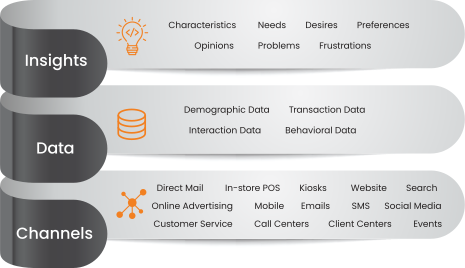
To build a consolidated view of customer journey, data needs to be collected right from inception when the customers come in as anonymous visitors, become known visitors, sign up for trials or demos, buy the product, start using it, click a display impression, view an email, all the way down to product’s click-level information. This huge pool of data then needs to be accessed, stitched together and analyzed to improve customer experience that can lead to business benefits.

Unified Analytical Platform

With various systems located at different places storing data in different formats, it becomes difficult to connect disparate data and use it to make strategic decisions. Data from these sources must be refined and integrated to build a unified platform.

Once the unified view is built, business users need tools that can help them access and analyze this data quickly. This would enable them to conduct deep analysis, get actionable insights and build strategies that drive desired business outcomes and improve customer experiences.

Integrate disparate customer and business data into a unified architecture and analytical experience that provides deep, connected insights to drive faster and more informed decisions.

Business Impact of Customer Journey Analytics

In-depth analysis of thousands of customer journeys that occur every day helps in conducting trend analysis, detecting unforeseen problems, identifying hidden opportunities, and planning future actions.

By analyzing the customer journey data in real-time, businesses can build strategies to engage with their customers and increase both customer delight as well as revenue.

Develop Customer-Focused Perspective

Visibility into the customer journey puts customers at the center of an organization’s decisions and actions. It provides insights into their behaviors, needs, expectations and problems. These insights can be used to develop a customer-focused perspective across the organization where every department and function uses the insights to deliver greater impact and better customer experience, enabling organizations to differentiate their business.

Increase Revenue

Insights from customer data can help organizations improve their customer experience. This boosts customer loyalty, improves retention and enables recurring business from existing customers. The insights can also be used to increase revenue by identifying opportunities for acquiring new customers

Identify Problems and Improve Processes

Customer journey analytics helps organizations identify issues and fix them. This reduces the number of complaints and saves money and effort. It also helps identify failure points and bottlenecks, revealing improvement areas. These insights can be used to improve processes and build better organizations.

Analytical Challenges

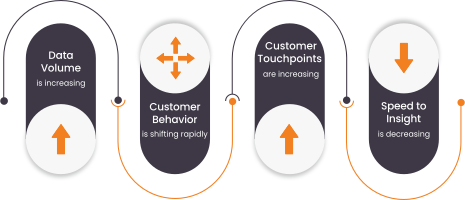
Most organizations today use the cloud or on-premise data lakes to store and manage customer data. But when it comes to analytics, they struggle to use this data. The main reasons analysis fails include volume, speed and complexity.

Data Volume Pains

With increased customer touchpoints and the amount of data produced during each interaction, data volumes have increased exponentially. Today, customers connect with the brands using multiple channels such as websites, mobile apps, call centers, social media, telephone, emails, point-of-sale systems, online and offline events, advertisements, partner campaigns, support and maintenance offerings and more.

All these sources generate a continuous and unending stream of data. Most analytics tools cannot meet the user’s expectations while dealing with such volumes.

Slower Speed to Insight

Speed to insight is an extremely important metric in today’s world, where customer behavior is constantly changing. Organizations need instant insights so that they can act quickly and engage with their customers at the right time through the right channel.

Most existing frameworks fail on query response times while handling massive data, so the insights are unavailable when needed.

Inability to Resolve Complex Problems

Some customer problems are simple, while others are complex and difficult to diagnose. The complex ones often go unresolved as organizations do not have the correct tools to determine the root cause.

To get visibility into the issues, business users need event-level granularity so that they can dig into data and identify the probable cause of an issue. They need access to both macro-level information to discover trends as well as micro-level information to detect and prevent problems

The Kyvos Solution

Kyvos’ innovative AI-powered smart aggregation technology helps engage with customers based on a data-driven understanding of their behaviors. It enables hyper-speed analytics on billions of individual customer interactions.

With Kyvos, users can query massive datasets, whether on the cloud or on-premise, in sub-seconds. At its core are smart aggregates that enable business users to access huge volumes of data instantly and analyze at any scale. Kyvos leverages modern data platforms for data storage. Since there is no data movement, additional infrastructure is not required, minimizing cost and maintenance overheads.

Kyvos allows users to slice and dice customer journey data in almost any combination and get the results in seconds, using the BI tool of their choice.

Unified Semantic Foundation

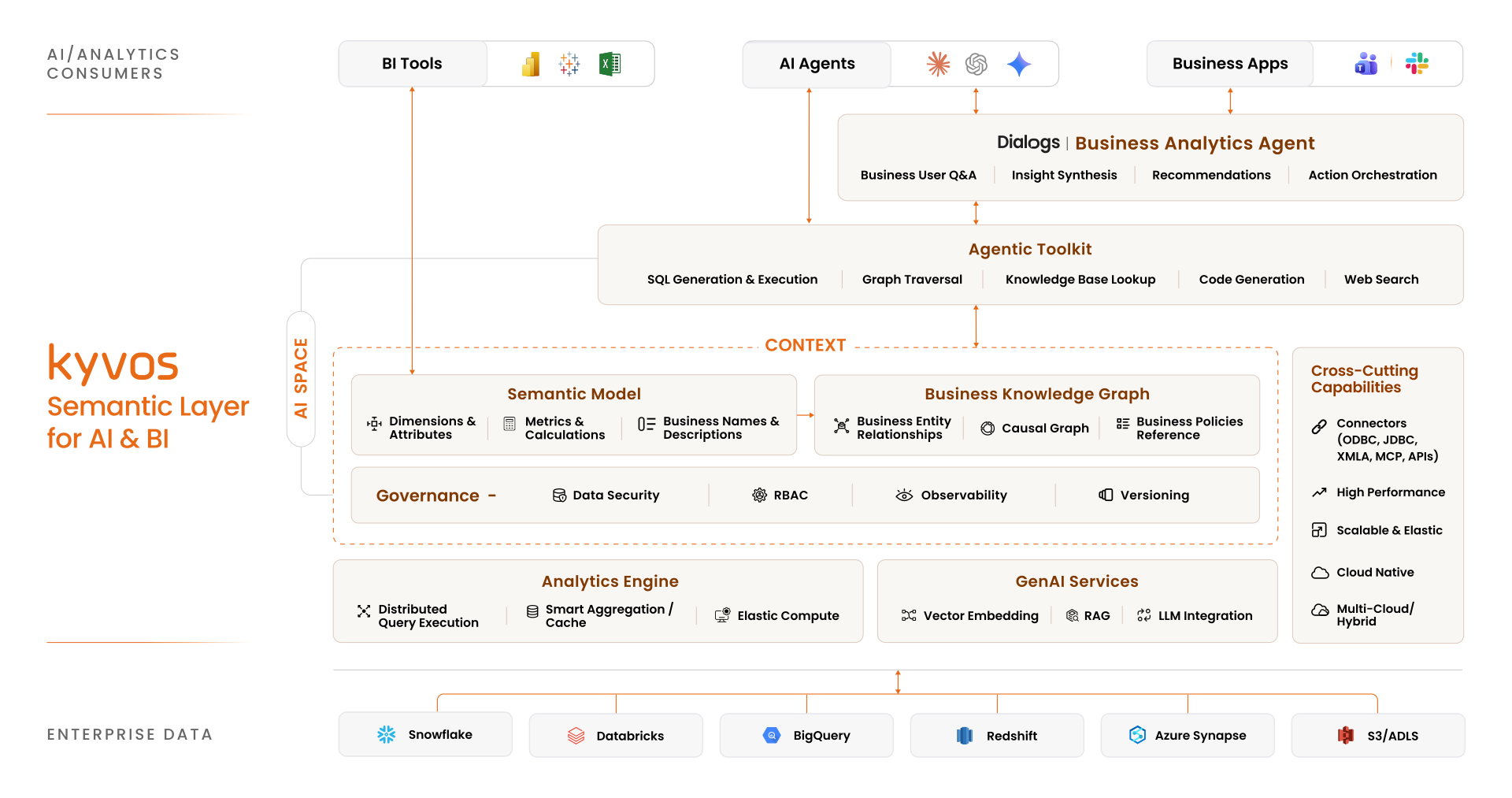
Kyvos semantic layer unifies all customer and business data into a consistent analytical framework. It provides a single source of truth where every metric, KPI, hierarchy, and dimension is standardized so all teams analyze data with the same definitions.

By abstracting underlying data complexity, Kyvos allows users to work with petabyte-scale customer interaction data in their existing BI tools—without needing SQL or deep technical expertise. It delivers governed, consistent, self-service analytics across departments and supports thousands of concurrent users with sub-second performance.

Instant Analytics on Massive Data

Analysts can run highly interactive queries on billions of customer interactions and receive sub-second results. They can explore event-level granularity, uncover root causes, and analyze across hundreds of dimensions without worrying about query performance or data size. This helps identify engagement opportunities and respond to customer behaviors in real time.

Scalable Solution

Kyvos supports active-active load balancing and high availability. Its architecture ensures near-linear scalability as data grows or new customer touchpoints are added—maintaining fast query response times even as analytical demand increases.

Analytics for All

Kyvos democratizes customer journey analytics by enabling business users to work within the BI tools they already use. Whether they prefer Tableau, Power BI, Excel, Looker, or others, they can perform advanced exploration seamlessly through Kyvos’ live connectivity. This ensures enterprise-wide adoption without retraining or workflow changes.

Next Steps

Customer journey data offers unlimited potential to build long-term relationships with customers and maintain a competitive edge. To tap into the real power of this data, businesses need to define the key organizational goals they want to achieve using this data. The objective can be to:

  • Improve the experience of customers by predicting their behavior.
  • Reduce the number of lost customers and identify cross-selling opportunities with existing customers.
  • Optimize channel performance and identify new channels.
  • Improve the quality of products.
  • Eliminate operational inefficiencies

Once the goals are clear, the next step should be identifying the right data sources and creating a consolidated platform that stores all the data in one place with proper governance. With this foundation in place, organizations can operationalize Kyvos semantic layer and accelerated analytics capabilities to make this data instantly accessible, consistent and actionable for business users. This way, enterprises can convert raw interactions into meaningful decisions that strengthen customer relationships and fuel long-term success.

About Kyvos

Kyvos is a semantic layer for AI and BI.

Built on a fully distributed, elastic architecture, Kyvos leverages AI-powered smart aggregation and ultra-wide, deep semantic models to deliver sub-second query performance on billions of rows — while optimizing for cost.

It provides a unified semantic foundation for 100% context-aware, enterprise-grade conversational analytics and AI agents, ensuring the highest accuracy and trust at scale.