Two AI agents at the same organization are asked the same question: Why did gross margin fall last quarter? Both query the same warehouse and write valid SQL. One blames a spike in returns, when a wave of earlier sales came back. The other sees no spike and blames higher freight costs. Both miss the main cause: a July pricing memo increased discounts for large accounts, reducing revenue while product costs stayed the same.
The warehouse holds the numbers. But their meaning, relationships and business explanations live in metric definitions, business rules and enterprise documents. AI context brings this information together, giving every agent a consistent, governed understanding of the business.
What is AI context?
AI context is the business understanding agents and LLMs need to interpret a question, retrieve the right data and produce an answer the business can trust and explain.
A large language model knows what margin means in general. AI context tells it what margin means at one specific company, which customers and contracts affect it and which decisions change it.
What Makes AI Context Complete? 7 Building Blocks Explained
Following are the building blocks of AI context that answer a different question an AI agent faces before it can respond reliably.
| Building block |
Question it answers for the AI agent |
| 1. Enterprise data |
Which data holds the answer? |
| 2. Semantics |
What does this metric mean here? |
| 3. Entities |
Which customer, product or supplier is this? |
| 4. Enterprise knowledge |
Which policy, contract or document explains this? |
| 5. Business relationships |
How do metrics, entities, concepts and knowledge connect? |
| 6. Query-time assembly |
Which context does this question need right now? |
| 7. Governance and lineage |
Who may see this, and where did it come from? |
1. Enterprise data: where do the numbers come from?
Every AI answer starts with data: the sales, cost, customer and operational records held in warehouses and lakehouses, such as Snowflake, Databricks and BigQuery. Policies, contracts and memos that explain those records live in tools like SharePoint, Confluence and Google Drive. AI context works on this data where it already lives.
2. Semantics: what does each metric mean?
Semantics are governed definitions of metrics, dimensions, hierarchies and business rules such as segments and exclusions. A semantic definition of net revenue states which transactions count and which deductions apply, so every agent and dashboard returns the same number.
A semantic layer for BI and AI provides this consistent foundation.
3. Entities: which customer is this?
Entities are the core business objects an AI agent reasons about, such as customers, products and suppliers. The semantic model defines each entity and how it joins to metrics. Entity resolution solves a separate problem: one customer often appears under different IDs in CRM and billing and under another name in its contracts. Matching those records and mentions to one identity keeps that customer counted once.
4. Enterprise knowledge: what explains the numbers?
Enterprise knowledge is the unstructured material that explains how a business runs: policies, playbooks, contracts, pricing memos, product documentation and meeting notes. Structured data shows that margin fell. A pricing memo shows why, and a contract clause shows whether the discount was a commitment.
Unstructured knowledge becomes AI context once it is linked to the entities and metrics it describes.
5. Business relationships: which concepts and drivers shape a metric?
Business relationships capture how the business reasons about its numbers, a layer above table joins. They define concepts such as “key account” or “at-risk renewal” and the taxonomies those concepts sit in. They also define metric trees that break gross margin into price, volume, mix and cost, plus driver relationships such as discount depth reducing margin.
A context graph is how these relationships are mapped. It connects metrics to the entities they measure, entities to the concepts they belong to and documents to the facts they explain. Each relationship carries metadata, causal links and the source it came from. An agent can then traverse several hops in one question: “Why did Northeast margin fall?” moves from the margin metric to its drivers, from the discount driver to the affected accounts and from those accounts to the memo that changed their terms.
6. Query-time assembly: which context does this question need?
Query-time assembly selects the relevant parts of the context graph for each question when it is asked and delivers them through governed agent tools, typically over the model context protocol (MCP). Use-case configuration scopes what an agent can draw on, and verified queries anchor common questions to proven answers.
Loading everything into a prompt raises token costs (the per-request cost of using an AI model), and pre-packaged context goes stale. Assembly per question keeps context current and scoped, provided it stays fast on billions of rows.
7. Governance and lineage: can the answer be trusted?
Governance and lineage are table stakes for enterprise AI. Access rules and masking follow each user’s entitlements through every agent, across data, graph and documents. Lineage traces each figure to its sources so any answer can be audited.
How do the seven building blocks work together?
The seven building blocks work as one connected system. Enterprise data provides the foundation. Semantics, entities and enterprise knowledge add business meaning. A context graph connects them, while query-time assembly selects what an AI agent needs for each question. Governance and lineage apply throughout.
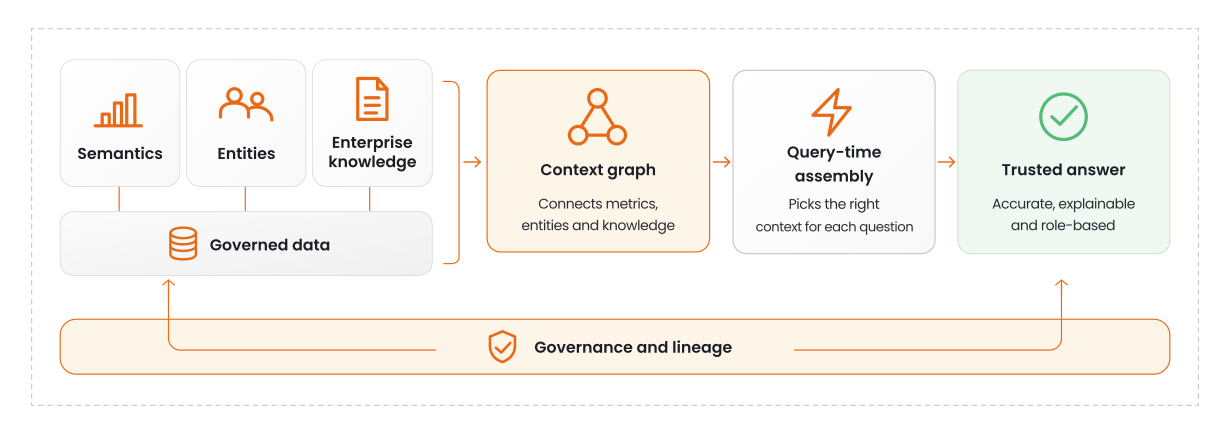
No single building block is enough. They work together to give AI a connected, governed understanding of the business.
What does AI context look like in practice?
Let’s understand with an example.
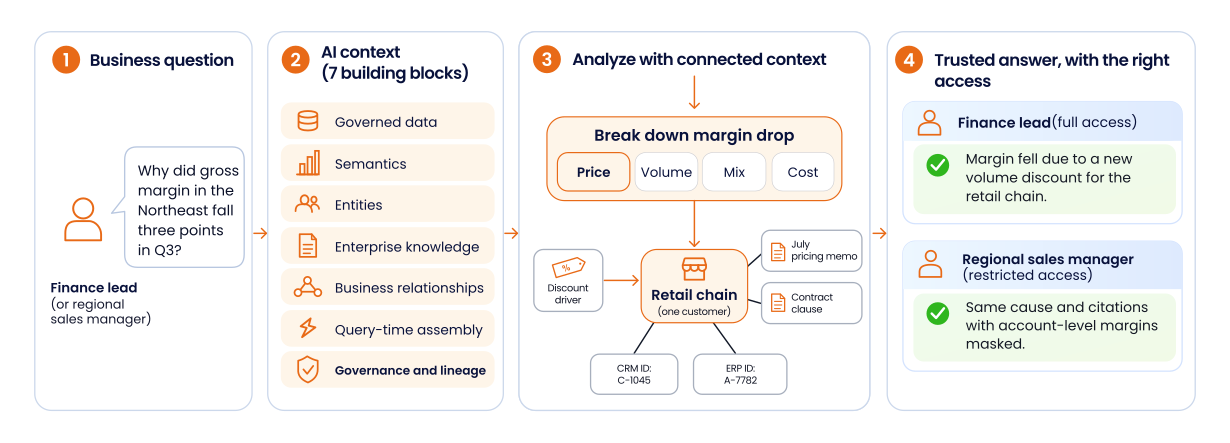
A finance lead at an electronics distributor asks an AI agent why gross margin in the Northeast fell three points in Q3.
Query-time assembly scopes the question to governed Northeast sales and cost data for Q3, leaving unrelated regions and policies out. The agent applies the governed definition of gross margin: net revenue minus landed cost (product cost plus freight and duties). It then splits the drop into price, volume, mix and cost, and price stands out.
Following the context graph from price, the agent reaches what seems to be three different retail accounts. AI context helps it figure out that it was the same retail chain recorded under two different customer IDs (in CRM and in ERP) and a third name in the contract with the distributor. The same context also leads to a July pricing memo and that account’s contract discount clause. Finally, the agent reports that most of the decline traces to the new volume discount on those accounts and cites the memo, the clause and the source tables.
Governance is built into the whole process. Instead of a finance lead, if a regional sales manager asks the same question, the agent returns the same cause and the same citations, but with account-level margins masked since the sales role has no access to them.
How does Kyvos deliver complete and connected context for AI?
Kyvos is a semantic layer that unifies semantics, entities, knowledge and relationships into complete and connected context for AI, in production today. Kyvos works on data where it already lives across cloud and on-premises platforms.
Kyvos semantic models define governed metrics, hierarchies, business rules and the entities those metrics measure.
Policies, playbooks and product documentation add enterprise knowledge alongside them. Kyvos’ context graph connects these elements through business relationships, and its causal paths and source bindings show why a metric moved and trace each figure to its source.
Kyvos assembles context dynamically for each question at query time and verified queries anchor agents to proven answers. Object-level security and masking apply to every query, backed by SOC 2 Type II, ISO 27001 and HIPAA certifications.
Next steps
To see how Kyvos assembles complete and connected context for AI on live enterprise data, talk to a Kyvos expert.





 Scale


 London
 Nov 16, 2026
