Open & interoperable

Built for choice, not lock-in

Technology stacks evolve. BI tools change. New AI models emerge. Kyvos lets you adopt new technologies without redefining your metrics, business logic, or context.

Quick Read

  • Evolve your data and cloud strategy without rebuilding logic
  • Bring any LLM or agent without rebuilding business context
  • Bring any BI tool without redefining business semantics
  • Built on open standards, including Apache Ossie—no lock-in
Data-Interoperability-right

The interoperability gap in enterprise architecture

Technology evolves quickly. Closed architectures don't. Every platform change forces rework, limiting flexibility and slowing AI innovation.

Every stack change means re-modeling metrics and logic

vector-n-shape

Logic applied differently across AI and BI—definitions drift between them

vector-four-circles

Adding or changing an LLM means reworking your AI applications from scratch

Logic sits in one vendor's proprietary format—no way to move or reuse it elsewhere

Analytics decoupled
from data platforms

Kyvos delivers platform-agnostic analytics that remain consistent as data platforms evolve—without duplication, rework or lock-in

  • vector-n-shape

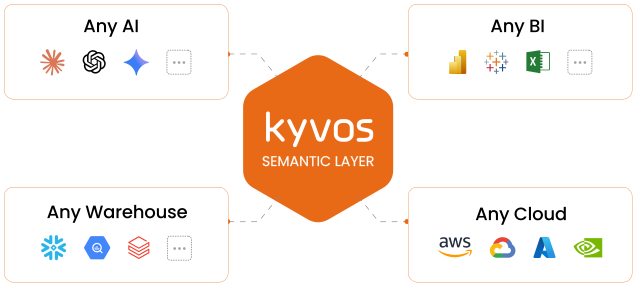
    Run analytics on semantic layer, wherever your data lives—across on-prem and cloud environments

  • Vector - 3

    No replication, re-modeling or forced platform standardization

  • Vector - 4

    Add or migrate platforms without breaking analytics

Semantics decoupled
from BI tools

Kyvos sits below the consumption layer, so BI tools can be added, swapped or run in parallel without rework

  • vector-n-shape

    Works with Tableau, Power BI, Excel, Strategy, Looker and more

  • Vector - 3

    One governed definition, consistent across every consumption tool

  • Vector - 4

    No more reconciling conflicting numbers across tools

  • Consistent, high-performance analytics across tools

Context decoupled
from AI models

Frontier AI shifts every month. Kyvos lets you switch models in and out without rebuilding business context or the analytics experience

  • vector-n-shape

    Swap or add AI models as they emerge

  • Vector - 3

    New model capability reaches production instantly, not in quarters

  • Vector - 4

    Delivers governed context to any AI agent over open protocols

  • Fast, governed answers at any data volume

Open standards,
no lock-in

Kyvos works with open and interoperable interfaces, like Apache Ossie, so nothing ties you to one vendor

  • vector-n-shape

    Define semantics once, exchange across any standards-based platform

  • Vector - 3

    Your semantic models stay yours, never vendor-locked

  • Vector - 4

    Active contributor to Apache Ossie (formerly OSI), not just a member

How Kyvos fits
in your analytics stack

https://staging.kyvosinsights.com/wp-content/uploads/2026/11/architecture-desktop-close.svg
https://staging.kyvosinsights.com/wp-content/uploads/2026/11/architecture-mobile-close.svg

FAQs

How does Kyvos stay open and flexible?
Your business context lives in one place, independent of the data platforms, BI tools and AI models around it. Each connects through standard interfaces, so you can add or change any of them while your context — and the foundation it runs on — stays intact.
Do we have to move our data into Kyvos?
No. Kyvos runs on one semantic model wherever your data lives — on-prem, hybrid or multi-cloud — with no replication or re-modeling when platforms change.
What happens when we add or replace a BI tool?
Tools can be added, swapped or run in parallel without rebuilding models, logic or reports. The same governed definition serves every tool, so numbers stay consistent no matter where people work.
Which BI tools connect to Kyvos?
Tableau, Power BI, Excel, Strategy, Looker and more — plus notebooks, custom apps and anything that speaks SQL, MDX or REST.
Can we switch LLMs without rebuilding our AI applications?
Yes. Business context stays in Kyvos, outside the model, so AI models can be swapped or added as they emerge while your applications and analytics keep working.
What is Apache Ossie, and how does Kyvos work with it?
Ossie (formerly OSI) is an open, vendor-neutral spec for the semantic layer — a standard format for metrics, dimensions and their relationships that any BI platform, query engine or AI agent can read. Kyvos is an active contributor, so your semantic model is portable by design, not tied to one vendor's format.
How does Kyvos avoid vendor lock-in?
Kyvos connects through open standards and the interfaces your tools already use, so your business context is never trapped in a proprietary format. You're free to add, swap or run tools and models in parallel.
Is security maintained when tools interoperate through Kyvos?
Yes. Kyvos enforces role-based access control centrally, so every tool and team follows the same security and data-access rules.