Abstract

Supply chain data, when leveraged fully, has the power to transform a business. This eBook showcases how Kyvos can help organizations to connect supply chain data, get instant visibility into SCM operations and use these valuable insights to improve business processes.

Introduction

Supply chain management has progressed from an operational and support function to a strategic game-changer, playing an important role in the success of an organization.

Business expectations have grown and supply chain leaders are constantly looking for new ways to increase efficiency, reduce costs and improve service levels across their networks. Traditionally, supply chains used transactional data to manage their inventory and delivery networks.

The rising volumes of data also bring forth the potential to get deeper and richer insights that can help build superior and more efficient networks. Organizations can explore massive amounts of structured and unstructured data to get insights that help optimize supply chains and gain a competitive edge.

Role of Data in Supply Chain Management

Data increases visibility into every aspect of the supply chain. It helps organizations get a holistic view of their supply and delivery networks that extend beyond the organization into supplier, partner and customer data.

The insights from this data can be used to improve different activities of the supply chain, such as procurement, logistics, inventory, production, distribution, transportation, etc. Organizations can leverage them to improve service, reduce costs and ensure better management of the supply chain resources. The availability of new forms of data offers new opportunities and can help solve several complex problems. For example:

  • Supplier data can align supply plans and monitor performances
  • Point of sale and user behavior data can help with demand forecasting and inventory planning
  • GPS and real-time traffic data can facilitate warehouse planning and delivery management

No wonder organizations today aspire to build intelligent supply chains that can anticipate demand, identify bottlenecks and foresee problems, empowering the businesses to take corrective and preventive actions in time.

The role of data in supply chain management has no value for organizations that cannot figure out how to use it. Developing proper mechanisms to transform data into trends and indicators can bring efficiency into supply chain networks.

Reduce Costs

Data provides several opportunities for process optimization and cost reduction. Organizations can analyze historical inventory data across thousands of products, stores and distribution centers and use the insights for better inventory management.

They can decrease costs by reducing days of supply, resolving excess inventory problems and improving inventory planning. Real-time visibility into supply chain activities also provides opportunities to cut down transportation and warehousing costs. Besides this, supply plans, transportation and other activities can be aligned with sales to reduce costs.

Monitor Performance

Organizations can analyze data over time to measure the performance and effectiveness of thousands of suppliers and transportation partners on key categories, including PO lead time, fill rate, inventory dollars, cost recovery, waste, backhaul and more.

The insights can be used to evaluate the performance of their partners and build better relationships. By analyzing inventory on multiple aspects such as product, classification, stores, distribution centers, suppliers and more, forecast accuracy can be improved at multiple aggregation levels.

Focus on Customers

Proper and updated data can help organizations drive a more customer-centric strategy by understanding their needs and preferences. By analyzing the customer data gathered from multiple sources and conducting trend analysis on it, organizations can get insights into their customers’ behavior.

This can help them adapt their assortments, both in-store and online, to offer exclusive and best-fit collections to their customers. By observing buy patterns, they can change their merchandise mix by location, time of the day, day of the week and more.

Identify Problems and Improve Processes

With the availability of huge amounts of granular data from a wide variety of sources, organizations can invest in building forward and reverse analytical capabilities that help them leverage data for improving processes.

They can track their product journey to get insights through reverse analytics. For example, even after the sale, organizations can look at the number of products bought, used, upgraded, exchanged, damaged, or returned and then analyze this data to understand issues and identify solutions.

Drive Strategic Decisions

Insights are not only useful at the operational level, but they can also drive decisions at the strategic level. Decisions such as strategic sourcing, supply chain network design and product development can be improved by using enterprise data.

In today’s global market, supply chains form an important component of business and they can be used to drive strategic transformations with the help of valuable and accurate insights.

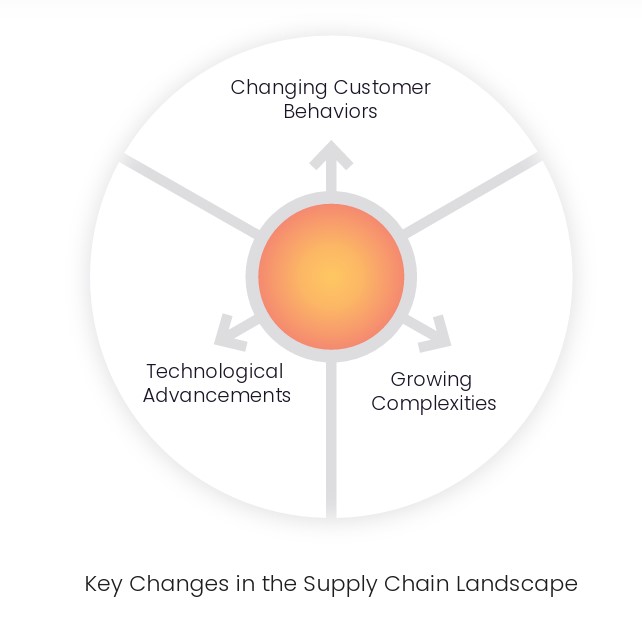
Evolution of the Supply Chain Ecosystem

As businesses become global and markets turn online, supply chains grow more and more complex. Today, organizations can reach a much wider audience, procure from international suppliers, outsource their delivery models and deliver custom products for specific markets.

Though these changes offer promising growth opportunities, they also introduce complexity and volatility into the supply chain. Therefore, it is crucial to understand these changes and how they affect the supply chain landscape.

Changing Customer Behaviors

To build effective supply chains, it is vital to understand the changes in consumer behavior. With the increase in options, consumer expectations have also gone up. They prefer flexible delivery models that allow them to try or test and provide the option to return or exchange. This not only complicates delivery but also increases costs.

Since consumers are online, mobile and always connected, they expect real-time updates on delivery information. In fact, in some markets, customers often base their purchase decisions on delivery convenience and speed.

Growing Complexities

Supply chain networks today have become more demand-driven. The availability of granular-level data enables organizations to anticipate and offer what they think their customers want, depending on their behavior and past actions. They can predict their customers’ needs by analyzing data, such as purchase history, search history, profile data, social activity and more.

Globalization of markets provides an opportunity to penetrate newer markets but increases logistics and supply chain activities. Besides this, increased competition and the pressure to sustain makes it imperative to reduce logistic costs.

Technological Advancements

With the availability of real-time GPS information, it becomes possible to achieve greater in-transit visibility. Organizations can use this real-time information to their advantage. Another technology that impacts supply chains is the recent advancement in IoT (Internet of Things).

Since the role of IoT is expected to grow in the future, supply chains need to build capacity to handle demands that originate from devices and sensors instead of coming from people and organizations.

Common Analytical Challenges

Despite the potential benefits of data, many organizations can still not utilize their data resources to improve supply chains or gain a competitive edge. Enterprise data can only be useful if it supports decision-making, both at the strategic and operational levels. Since more data does not necessarily mean more insights, it is important to examine the key challenges that organizations face in analytics and then build solutions to overcome those challenges.

Inability to Analyze High Data Volumes

With vast amounts of data coming in from several diverse sources, organizations often find its volume and speed overwhelming. Most analytical tools that worked well earlier fail to meet user expectations while handling the continuous influx of massive supply chain data.

Delay in Insights

Poor speed and slow responsiveness of the analytics tools while handling data often force business users to go through long waits for the insights they need. The IT teams find it difficult to support their needs and are in a constant catch-up mode when it comes to storing, interpreting and presenting data to business users.

Lack of Accessibility to Business Users

Another key reason organizations are underutilizing their enterprise data is that they cannot plan and deploy analytics at suitable levels in the organization. They find it challenging to provide interactive analytics capabilities to business users who can use the insights to take timely actions and improve the supply chain.

Barriers to Change

As the nature and scale of data change, organizations tend to bring in new tools and technologies that can handle that data. But sometimes, users may be unwilling to adopt new analytical tools or methods. To drive adoption through the organization, these technologies should not require the business user to learn complex new systems.

Global Disruptions

Global events like the recent pandemic leave the supply chains in shock and cause shortfalls. The industries face increasing difficulties adapting to the emerging channel mix to serve customers better. Historically, there has been a severe lack of better preparation and supply network mapping in the industry. This means the supply chain managers need systematic information on procurement processes, schedules and roles.

“ If supply chain leaders don’t prepare for the ecosystems in which future supply chains will operate, they are at risk of not foreseeing and preparing for the inevitable disruption. They must have a forward view even when faced with unforeseen challenges, such as the recent pandemic.”

Michael Burkett,
Distinguished VP Analyst, Gartner.

The Kyvos Solution

Any Data Size. Any Complexity. Instant Insights.

Kyvos helps improve supply chain through instant analytics on any volume of data stored on the cloud and on-premise data platforms.

The impact of data explosion on supply chains can transform how they are managed. Enterprises need a structured approach to access, understand and utilize this data for better decision-making. Kyvos intends to simplify this process with instant insights across thousands of retail stores, millions of products and billions of transactions. Kyvos’ advanced solutions allow organizations to:

  • Consolidate reporting
  • Analyze years of data in seconds
  • Deep dive into metrics that matter
  • Reduce analytics cost

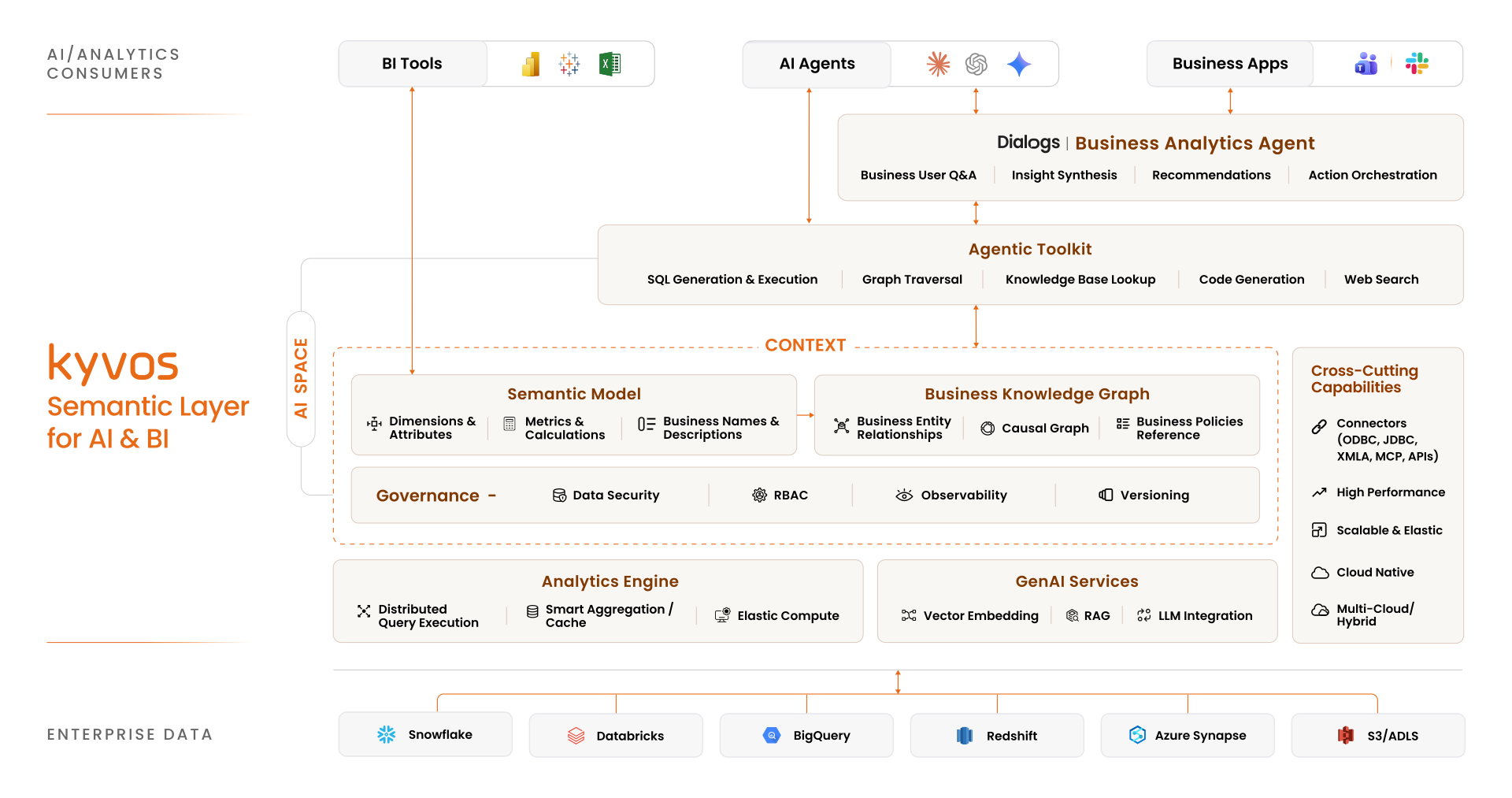
Kyvos bridges the gap between technology limitations and business needs. With its AI-powered smart aggregation technology, users can gain instant insights and visibility into the supply chain network. Whether they need to perform trend analysis on years of historical data or get deep insights into store-item level information, nothing’s impossible with Kyvos.

Kyvos ArchitectureKyvos Architecture

Instant BI Drives Business Outcomes

Supply chains distributed across stores, geographies and vendors need better and faster access to critical data. Kyvos’ AI-powered smart aggregation technology allows enterprises to analyze all of their data with ease and speed. With Kyvos, they can slice and dice data in almost any combination and get the results in seconds, using the BI tool of choice.

  • Query data without limitations while getting responses in seconds.
  • Analyze inventory data for millions of product SKUs across thousands of stores and distribution centers interactively and use the insights to reduce inventory costs and improve forecast accuracy.
  • Explore billions of transactions from thousands of suppliers and evaluate their performance on a month-to-month or year-to-year basis.
  • Drill down or slice and dice any data with ease, getting to the core of the problem.

Easy Scalability for Future Requirements

Kyvos’ infinitely scalable platform eliminates the speed and scalability barriers of the traditional BI tools. It is designed for scalable deployments on modern data platforms to cater to thousands of users across the organization. Kyvos supports multiple dimensions and unlimited granularity, enabling enterprises to deep dive into any business metric that matters.

  • Scale for thousands of concurrent users, years of data or additional dimensions
  • Extend controlled access of data to thousands of suppliers, partners, distribution centers and stores without any significant effect on performance. Kyvos delivers near-linear scalability as new users or data sources are added while providing quick response times and high availability.
  • Our scalable platform helps you gear up for the future, where supply chains will be more complex and newer data sources will be available. Managers can take action to reduce days of supply or identify the root cause of excess inventory.

Self-service, Interactive BI for All

Organizations can simplify analytics for business users by allowing them to use their existing BI tools. With Kyvos, users can create dashboards, charts, time-series graphs and more on huge amounts of data. They do not need SQL knowledge or programming expertise for data exploration and analysis.

Kyvos supports all popular BI tools such as Tableau, Power BI, Strategy, Excel, Looker and more. Its semantic layer creates a consistent data view so that any person across the organization can query from anywhere and get a standard view of results across the board. This can help improve planning process and focus on cost reduction.

  • Empower users with the power of data and help them find answers to their business questions without dependency.
  • Build dashboards to get a summary of key metrics across all areas in the supply chain, including sales, forecast, inventory, costs and service levels.
  • Evaluate the performance of suppliers and transportation partners by creating graphs that demonstrate key parameters such as PO lead time, fill rate, inventory dollars, cost recovery and more.
  • Create reports to evaluate and track forecast accuracy at multiple aggregation levels to identify exceptions and plan adjustments.

Kyvos transforms analytics by allowing users to slice and dice enterprise data in almost any combination and get the results in seconds, using the BI tool of choice.

Conclusion

Ever-changing market dynamics and growing data volumes are forcing companies to rethink their supply chain strategy. Handling rapidly changing customer behaviors and cost pressures requires a fundamental shift in how analytics is approached.

Supply chain leaders need an environment that offers seamless access to data and empowers users to solve real-world problems without dependency. They need a self-service, governed and interactive platform that connects every data source and delivers insights at the speed of business.

Kyvos semantic layer bundles all these capabilities into a single platform, delivering lightning-fast, cost-efficient analytics on 100% of enterprise data. It unifies complex supply chain data—from suppliers and distribution centers to stores and customers into a consistent, governed view. This enables every stakeholder to analyze and act on the same version of truth, making decisions faster.

About Kyvos

Kyvos is a semantic layer for AI and BI.

Built on a fully distributed, elastic architecture, Kyvos leverages AI-powered smart aggregation and ultra-wide, deep semantic models to deliver sub-second query performance on billions of rows — while optimizing for cost.

It provides a unified semantic foundation for 100% context-aware, enterprise-grade conversational analytics and AI agents, ensuring the highest accuracy and trust at scale.