Abstract

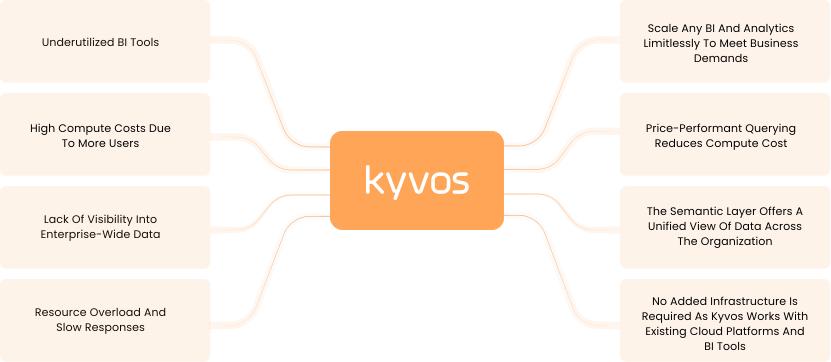
Enterprise data is growing at an exponential rate. While cloud storage remains relatively affordable, the computing power required to process and analyze this vast volume of data can significantly drive up cloud costs. Kyvos reduces these costs with its AI-powered smart aggregation technology while delivering unparalleled analytics performance.

Introduction

Either an organization is already on the cloud or migrating to it – that’s the new normal. While the cloud promises lower costs, this is not always true, especially when consumption and computing needs are skyrocketing.

Whether data is stored and analyzed on cloud data warehouses like Snowflake or Databricks or through cloud data platforms such as AWS, Azure, or Google Cloud, querying costs continue to rise with increasing users and data volumes. Reducing cloud costs and optimizing the use of cloud resources has become a critical priority. Cloud cost optimization with Kyvos offers a strategic solution to this challenge, applying a targeted process that helps reduce cloud costs by 45%.

Reducing cloud usage or migrating to a less expensive cloud provider isn’t the solution as data influx increases unpredictably and organizations need to scale up their analytics capabilities as per their requirements. Kyvos addresses these challenges with the right strategies, technologies and methods that not only reduce cloud costs substantially but also deliver exceptionally high analytics performance.

For data leaders, the biggest impediment in higher cloud adoption is managing multiple resources and controlling costs without compromising on the speed of analytics or the scale of queries they need to run for critical decision-making.

Why Do Organizations Need to Control Cloud Analytics Costs?

As organizations increasingly build their data programs on the cloud, cost management becomes a key challenge for data engineering teams. While most cloud platforms offer scalability and elasticity to manage overall costs, they often fail to deliver the same benefits when data size and user numbers grow exponentially.

Cloud cost optimization should not be a reactive control. Instead, adopt a proactive approach that helps build a robust and elastic analytics architecture to prevent cost explosion without compromising on analytical needs.
Monitor Cloud Resources for Optimum Utilization

An organization’s BI architecture must be elastic to scale up and down with growing usage and data volumes. However, data and business leaders may find it difficult to rationalize these costs when analyzing massive volumes of data. They need to monitor cloud consumption to mitigate these challenges.

If consumption isn’t monitored, costs can explode and reduce ROI. Conversely, reacting only to expected spikes can lead to wasted resources when analyzing massive ampunts of data at once. Identifying the right cost metrics at the right time can prevent this issue.

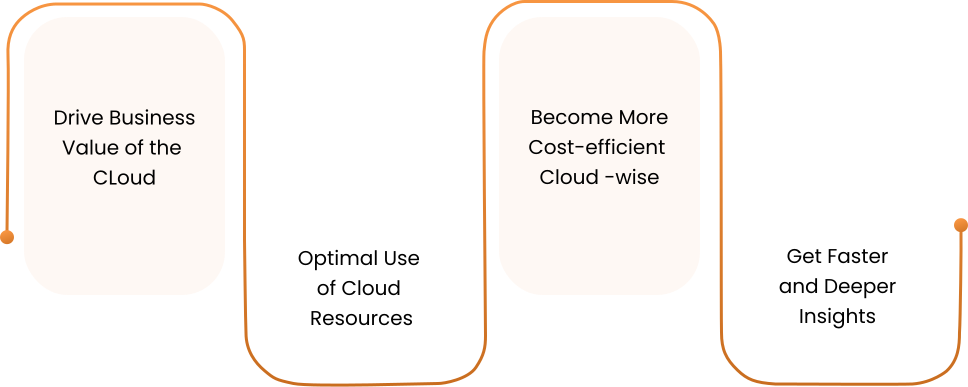
With cloud cost optimization, organizations enable their teams to make quicker decisions at every level, using cloud resources optimally to drive data-based decisions.

Enable Data Democratization

As the number of users in an organization increases, data consumption rises proportionately. More users result in more queries and higher compute costs, even when cloud data storage remains cost-effective. However, organizations can enable easy and equitable data access for all users by optimizing monthly consumption expenses.

Cloud cost control facilitates resource optimization and allows organizations to adopt a culture of data democratization where all information is readily available to all users without any IT dependency. It ensures self-service analytics when any user can access the data to dig into details and get a unified view or a single version of truth enterprise-wide.

Get Better and Faster Insights

Don’t let teams grapple with high data volumes and out-of-control expenses when they should focus more on their core tasks. A proactive cost optimization strategy will help them plan their resources and operations.

The process will also bring more opportunities to improve their cloud BI environment with new capabilities. When the number of users grows, it can simultaneously increase the number of concurrent requests on cloud BI tool.

Organizations must prepare their cloud data warehouse with the right resources to face this issue and offer unified, optimum visibility into their cloud costs, resources and tools.

Enhanced Business Efficiency

When people have ready access to data without any limitations, they are more likely to focus on their core skills and innovate new ways of doing things. Better insights and faster analytics open new avenues to explore data and make better business decisions.

Bring more effectiveness to business processes and workflows by enabling teams at all levels without worrying about cloud costs shooting off. Organizations with multiple teams using cloud resources repeatedly can save more cloud costs without affecting the productivity of each team.

Challenges of Managing Cloud Analytics Costs

Not every enterprise has the right resources to manage its cloud bills and avoid overspending on data storage and BI. They may face challenges like:

Over-provisioning or Underutilization of Resources

Several factors can contribute to high cloud bills, but one of the most common is over-provisioning. This happens when businesses allocate more resources than they need to run their BI workloads. While having some extra capacity to handle spikes in demand is essential, having too much can be a waste of money. Cloud cost optimization can help in allocating right-amount of resources so that businesses only have to pay for the resources they are actually using.

Another common problem is underutilization. This occurs when enterprises have resources that are sitting idle most of the time. For example, they may have a server that’s only used during business hours but stays powered around the clock.

Performance Issues

For growth-oriented modern enterprises, democratizing data access to multiple users is the need of the hour. However, their data consumption will rise with more users. They may inadvertently increase their cloud computing costs when analyzing the stored data repeatedly.

Hence, investing in optimization platforms and tools that complement their existing cloud stack and enable analytics on large datasets without latencies is essential.

Visibility Issues

When migrating BI processes to the cloud, organizations can’t risk losing critical enterprise data to any vulnerability. They must control access to crucial resources and enable data democratization at every level.

That’s not all, either. Maintaining enterprise-wide visibility into data requires more than what a cloud platform offers. Even if the dashboard is visually appealing and fulfills an organization’s analytical needs, it may not be fast enough to make the right business decisions at the right time.

The Kyvos Solution

Your BI Tool. Your Cloud. Any Data Size.

Prioritize business needs without worrying about analytics costs or efficiency with Kyvos. Our AI-powered aggregation technology and smart data engineering can help organizations get deeper insights into any amount of data while optimizing their cloud costs.

Kyvos’ cloud-native semantic layer enhances analytical capabilities and helps maximize return on investment (ROI). Organizations don’t have to worry about the integrations. Kyvos can complement their cloud stack and BI tools seamlessly for fast and self-service analysis.

AI-Powered Smart Aggregation Technology

Kyvos’ AI-powered smart aggregation technology lets organizations aggregate all their data in advance. Since most queries are already processed and aggregated, they save substantially on compute costs at runtime.

Our price-performant querying approach lets users query any number of times without huge runtime costs.

Kyvos uses its ML-based recommendation engine to profile data and study query patterns which further optimizes their aggregates. It not only helps them improve performance but also reduces storage costs

Load-Based Elasticity

Our load-based elasticity enables that in the case when no queries are running, all the Kyvos query engines will go down automatically and when a query comes, then the query engines get started automatically.

It helps organizations manage system capacity and reduce unnecessary costs. Kyvos also provides auto-scheduling of query engines as per predicted loads. Based on the business usage pattern, they can scale up or scale down querying capacity and reduce costs with optimal resource utilization.

High Concurrency

In cloud data warehouses, increasing number of users and queries, processing infrastructure and costs grow linearly or even exponentially.

However, it’s not the same in Kyvos and they can support 1000s concurrent users from the same infrastructure without impacting costs.

What’s in Store for the Future

Experts and industry leaders predict that overall cloud spending will reach $2 trillion in the next few years as more enterprises join this bandwagon. Kyvos can help organizations optimize their cloud ROI with a cloud-native architecture that keeps their BI costs under check.

Our AI-powered smart aggregation technology delivers faster insights at minimum costs on unconstrained datasets. We believe – “With higher elasticity comes more cost savings.”

Explore our platform more to see how.

About Kyvos

Kyvos is a semantic layer for AI and BI.

Built on a fully distributed, elastic architecture, Kyvos leverages AI-powered smart aggregation and ultra-wide, deep semantic models to deliver sub-second query performance on billions of rows — while optimizing for cost.

It provides a unified semantic foundation for 100% context-aware, enterprise-grade conversational analytics and AI agents, ensuring the highest accuracy and trust at scale.